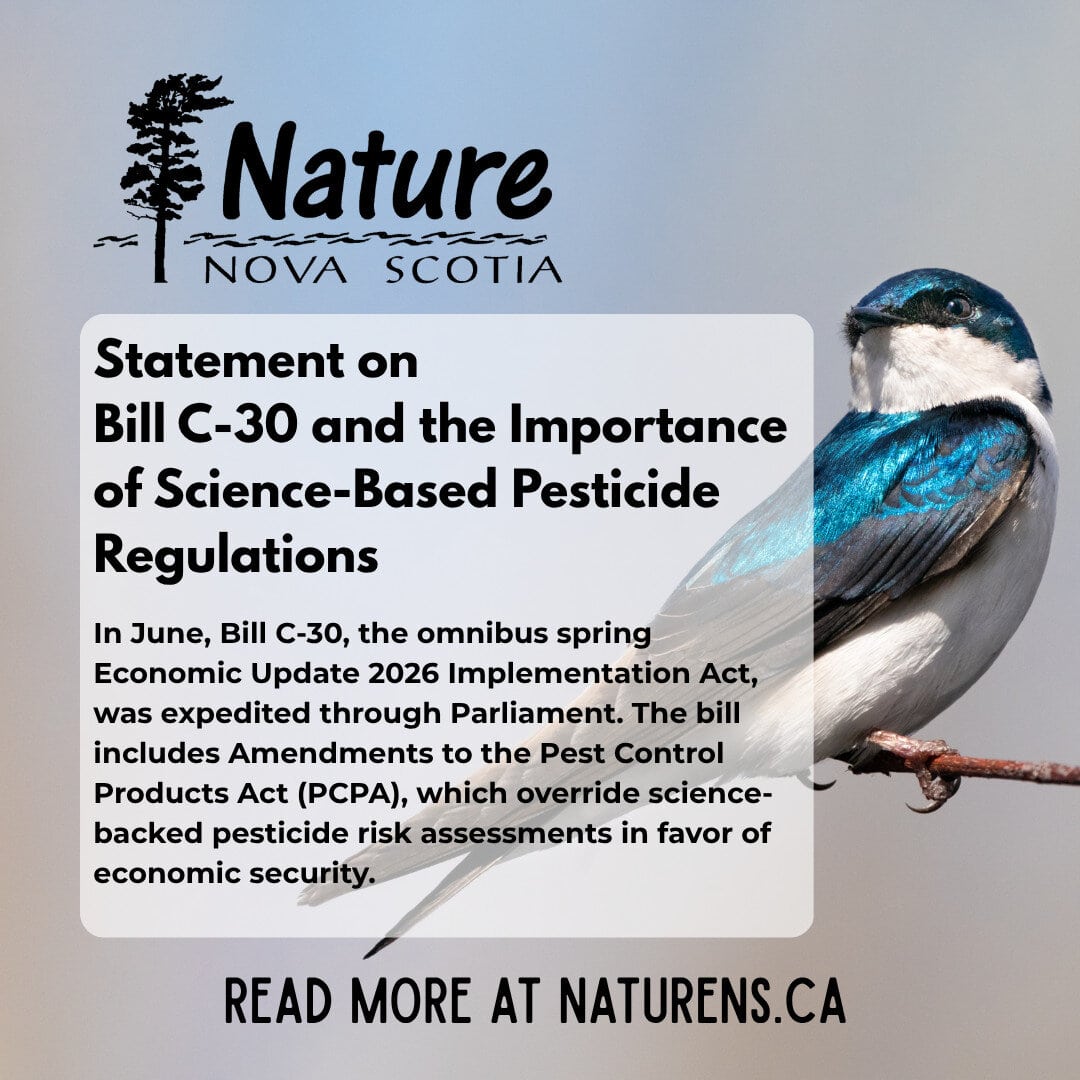
Nature Nova Scotia’s Statement on
Bill C-30 and the Importance of Science-Based Pesticide Regulations August 31, 2026
Bill C-30, the omnibus spring Economic Update 2026 Implementation Act, was expedited through Parliament and passed under much controversy in June, enacting major changes to taxation, skilled trades, housing, and pesticide and food safety regulations. While Nature Nova Scotia is not commenting on every aspect of the Act, we are deeply concerned by the amendments to the Pest Control Products Act (PCPA) that are hidden within it. These changes are among the largest in Canadian pesticide control history and could have significant consequences for how decisions are made about pesticide use in Canada.
Nature Nova Scotia represents a network of natural history societies, environmental organizations, and individuals across the province who are committed to conserving biodiversity and protecting Nova Scotia’s natural heritage. We know that healthy ecosystems support healthy communities, resilient local economies, clean water, and long-term food security. For more than two decades, Canada’s pesticide regulatory system has been built on a simple principle: decisions about pesticide approvals and restrictions should be based on scientific evidence that protects both human health and the environment. Application of the scientific lens to decision making allows governments to identify risks before harm occurs. It is how we ensure that decisions affecting public health and the environment are evidence-based rather than based on short-term economic or political interests.
Bill C-30 changes Canada’s pesticide regulatory framework by requiring regulators to “consider” national economic security, regional economic security, and food security alongside scientific assessments in decisions about pesticide use. It also gives Cabinet the authority, in as of yet undefined circumstances, to override science-based regulatory decisions, approve previously banned pesticides, and override valid health and environmental concerns to address economic uncertainty and food security. This creates the possibility that economic or political considerations could take precedence over evidence about risks to human health and the environment, while ignoring the complex and interrelated causes of food insecurity.
We are also concerned by proposed changes under Bill C-31 that would replace Canada’s mandatory 15-year pesticide re-evaluation process with a less clearly defined assessment framework. Regular, transparent reviews ensure that regulatory decisions keep pace with new scientific knowledge, emerging environmental risks, and safer alternatives. Removing that certainty weakens an important safeguard for both biodiversity and public health.
Pesticides should be approved, restricted, or prohibited based on the best available science. Decisions about products that may harm pollinators, wildlife, water quality, or human health should not be driven by short-term economic pressures. Supporting Canadian agriculture and food security is essential, but these objectives should complement, not override, science-based environmental protections. Allowing for the use of dangerous pesticides under uncertain conditions and jurisdiction is to put a bandaid on a system already destabilized by climate change.
Nature Nova Scotia recognizes that Canadian farmers are facing real challenges to normal operations at present, such as extreme weather, surging fuel and fertilizer costs, and constantly changing commodity prices influenced by the linked biodiversity and climate crises as well as local and international conflicts. Food security and a strong agricultural sector are essential to Canadian wellbeing, but a sustainable agriculture industry depends on healthy ecosystems. Farmers know this. Organizations like the National Farmers Union (NFU) and the Canadian Organic Growers (COG) have condemned Bill C-30, arguing that overriding science-based decisions politicizes environmental safety so that corporations could use economic security and food security arguments to lobby Cabinet Ministers to recommend exemptions to laws and regulations and, ultimately, endangers long-term environmental health. The NFU also rightly points out that Cabinet deliberations are confidential, so citizens cannot know how or why exemptions were made. COG shares our concerns that terms such as “national economic security”, “food security”, and “regional economic security” are not defined in the legislation and also point out that the bill being omnibus and pushed through during the height of farming season limited meaningful consultation. Nature Nova Scotia supports these farmers concerned for the health of our shared natural environment and destabilization of our science-informed and democratic decision making processes.
Instead of frenzied regulatory reductions putting Canadians and Canadian wildlife at risk, we suggest implementing the security measures Canadian farmers have already asked for: delivering targeted financial disaster relief, providing cost-shared grants for climate-resilient infrastructure, offering specialized agricultural loans, supporting local market growth, and helping to recruit and retain new young farmers, all of which carry benefits for the local nature our farmers steward.
Healthy soils, thriving pollinators, clean water, and resilient ecosystems are the foundation of productive agriculture and food security. Decisions that prioritize short-term economic or political considerations over scientific assessment risk creating larger environmental and economic costs in the future. We urge the Government of Canada to maintain science as the cornerstone of pesticide regulation, preserve independent review processes, and ensure that decisions made today do not compromise the health of our environment for future generations.
Jess Lewis, Conservation Programs Coordinator
and Chair of the Bird Friendly Halifax Coalition
jess.lewis@naturens.ca
Becky Parker, Executive Director
becky.parker@naturens.ca
Further Reading
“Public interest groups slam changes to federal pesticide law as unwarranted, dangerous and undemocratic”, Ecojustice, June 19th, 2026: https://ecojustice.ca/news/public-interest-groups-slam-changes-to-federal-pesticide-law-as-unwarranted-dangerous-and-undemocratic/
“Bill C-30, the Spring Economic Update Implementation Act – NFU Submission to Finance Committee” National Farmers Union, June 9, 2026: https://www.nfu.ca/policy/bill-c-30-the-spring-economic-update-implementation-act-nfu-submission-to-finance-committee/
“COG Statement on Bill C-30” Canadian Organic Growers, July 8, 2026: https://cog.ca/blog/cog-statement-on-bill-c-30/
“Amendments buried in Bill C-30 weaken environmental protections” Canadian Association of Physicians for the Environment, June 18, 2026: https://cape.ca/press_release/amendments-buried-in-bill-c-30-weaken-environmental-protections/
“Tackling the Farm Crisis and the Climate Crisis” National Farmers Union, 2019: https://wwA Vision of a Near-Zero-Emission Farm and Food System for Canada
“A Vision of a Near-Zero-Emission Farm and Food System for Canada” National Farmers Union, March 2021: https://www.nfu.ca/publications/imagine-if-a-vision-of-a-near-zero-emission-farm/